Reading Comfort
Are reading pillows worth it?
The honest comparison is not against another backrest. It is against the two ordinary pillows you already own and stack behind you, which cost nothing and almost work.
By Scooter M. · Published · Last updated
How we are paid: the buy links on this page are affiliate links. If you buy through one, Amazon pays us a commission at no extra cost to you. It does not change what we rank or what we tell you to skip — the full disclosure is here.
| # | Gift | Height | Best for | Score | Price |
|---|---|---|---|---|---|
| 1 | 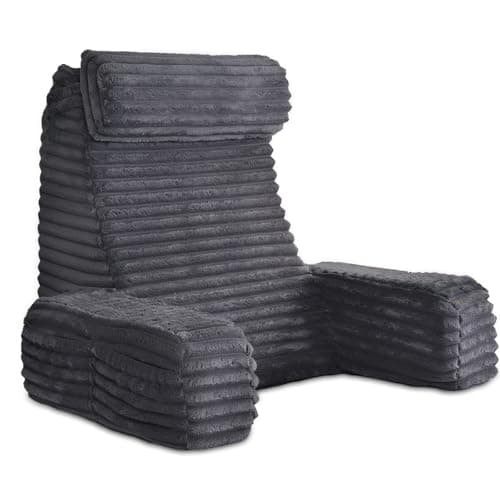 ENITYA 22 in XL Back Pillow Twenty-two inches of two-layer foam at a published 60-degree recline, with pockets on both sides — the biggest backrest here. | 22 in | Tall people and long evenings | 8.0 | $50.99 on Amazon |
| 2 | 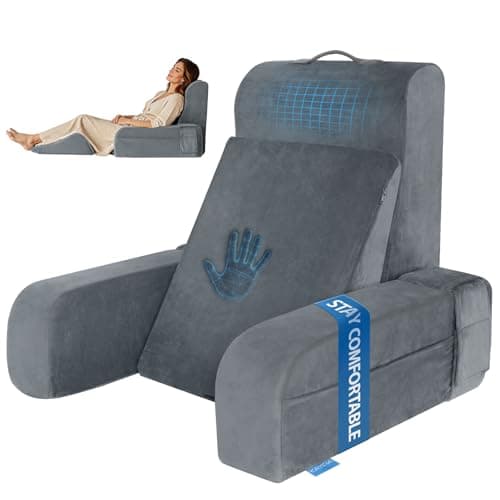 Kayfia Gel Memory Foam Reading Pillow, 19 in Nineteen inches, firm foam under soft memory foam, with detachable armrests the seller specifically pitches as wider than the usual. | 19 in | Arms that actually stay on the armrest | 7.4 | $41.99 on Amazon |
| 3 | 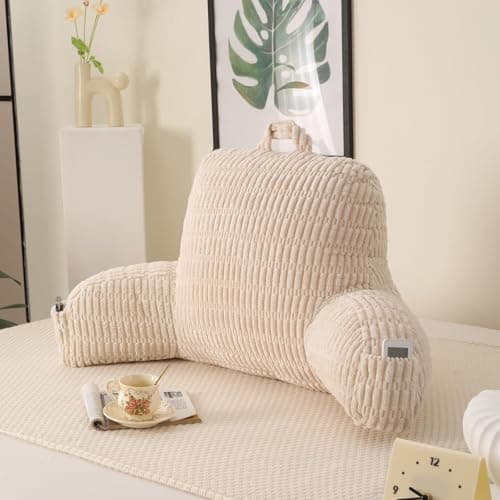 PAJEO Corduroy Reading Pillow OEKO-TEX certified, 500 gsm corduroy over 7D high-resilience fiber, with a machine-washable cover — six of six specs published. | Not published | The best-documented one | 8.2 | $25.99 on Amazon |
| 4 | 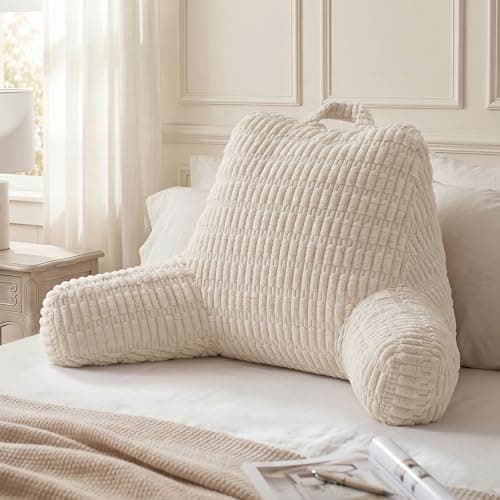 Blissful Diary Reading Pillow Shredded foam behind an inner zip, so the firmness can be changed after it arrives, with a machine-washable outer cover. | Not published | Adjusting the firmness yourself | 7.5 | $29.99 on Amazon |
| 5 | 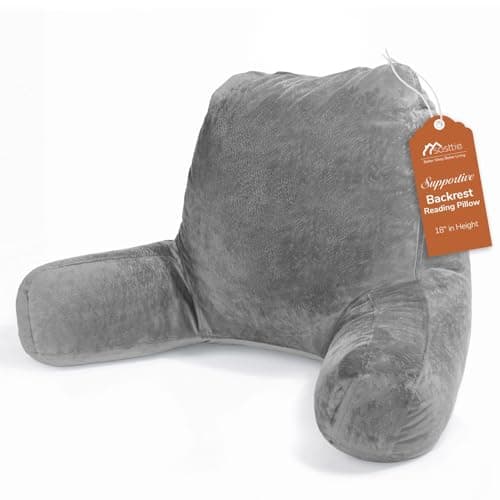 Sasttie Reading Pillow The only backrest here that publishes how much filling is in it — 4.5 lb of high-resilience polyester under 200 gsm fabric. | Not published | A published fill weight | 7.1 | $28.98 on Amazon |
Every “worth it” question is really a comparison, and the comparison here is not between two backrests. It is between a backrest and the two pillows you already own and prop behind you. Those cost nothing, are already on the bed, and work for about fifteen minutes.
What stacked pillows actually fail at
Three specific things, in the order you notice them:
- They collapse. A pillow is designed to compress under a head. Under a back it compresses further, so the angle you set up at is not the angle you are sitting at twenty minutes later, and you rebuild the stack instead of reading.
- They slide. Nothing holds a stack against a headboard. Every adjustment is a small interruption, and the interruptions are what end the session.
- There is nowhere for your arms. This is the one people do not predict and the one a backrest most obviously solves. Holding a hardcover with unsupported arms is the actual reason an hour of reading in bed gets uncomfortable, and it is why every product in this category has arms.
A backrest fixes all three by being a different object: firm fill that does not compress to nothing, a wide flat base that sits against the headboard, and two arms.
When it earns its place, and when it does not
If you read lying down, the honest answer is that no backrest helps and the equipment that does is different entirely — hands-free reading covers that position. If you read in a chair, book holders for reading in a chair is the page you want instead.
The spec that decides it, and how often it is missing
Height. A backrest that reaches your shoulders changes how an evening feels; one that stops at the middle of your back is a cushion you paid extra for. It depends on your own height and on how far the mattress sits below the headboard, so it is a number you need.
Of the five backrests in our registry, two publish a height — 22 inches and 19 inches — and three do not. That is the single strongest argument against the category as it is currently sold: the spec that determines whether the product works for your body is the one most sellers leave out, and no amount of photography substitutes for it.
Measure from the top of your mattress to the point on your back you want supported before you shop. Our reading pillow comparison ranks the field on height, fill and washability.
The costs nobody puts on the listing
- It has to go somewhere at night. A 22-inch backrest with arms is a large object. In a small bedroom it lives on the floor, against a wall, or it stays on the bed and you sleep around it. This is the most common reason one stops being used.
- Washability is not universal. A thing you lean against nightly gets grubby. Three of our five publish a removable, washable cover; the others do not say.
- The fill decides the lifespan. Shredded or high-resilience fill recovers its shape; cheap polyester wadding flattens and you are back to the problem you bought it to solve. One seller publishes a fill weight in pounds, which is the most checkable version of this.
So: worth it or not
Worth it for a regular in-bed reader with an hour to give it, for anyone whose bed has no headboard, and for anyone who has noticed their arms rather than their back getting tired. Those three cases are the whole market and the product genuinely solves them.
Not worth it as a gift for someone you have not seen read in bed, because the height has to match them and most listings will not tell you the height. That makes this one of the few things on this site we would hesitate to recommend buying for somebody else. How to choose a gift for a reader works through where that line sits.
The five below are ranked on what their sellers publish, with the blanks printed as blanks.
Every pick
All of them, in full
Each write-up shows the gift-fit score broken into its five parts, the specs the seller actually publishes, and who should give it a miss.
No. 1 — Tall people and long evenings
ENITYA 22 in XL Back Pillow
Twenty-two inches of two-layer foam at a published 60-degree recline, with pockets on both sides — the biggest backrest here.
| Spec disclosurecomputed | 17 / 20 |
|---|---|
| Gift readinessour call | 16 / 20 |
| Works for any readerour call | 14 / 20 |
| Materials and buildour call | 16 / 20 |
| Everyday useour call | 17 / 20 |
| Total | 80 / 100 |
| Height | 22 in Seller’s product title, read 2026-09-07 |
|---|---|
| Fill | Two-layer composite — high-density foam for support over high-resilience foam Seller’s listing, read 2026-09-07 |
| Cover material | Plush faux fur Seller’s listing, read 2026-09-07 |
| Arms | Armrests, on a 60-degree ergonomic backrest angle Seller’s listing, read 2026-09-07 |
| Pockets | Extra-large pockets on both sides Seller’s listing, read 2026-09-07 |
| Removable cover | Not published Not published |
Twenty-two inches is genuinely tall — most reading pillows in this bracket are seventeen to nineteen — and height is what decides whether a backrest supports the shoulders or stops halfway up. For a tall person, or for anyone who has found these pillows unsatisfying before, this is the specification that explains why.
The published 60-degree recline is unusual and useful. Reading pillows vary between about 50 and 70 degrees, and where they sit in that range decides whether it is a sit-up-and-read pillow or a lean-back-and-watch one. Sixty is the reading end of that.
Foam rather than fiber fill means it does not compress the way a stuffed pillow does, and the two-layer composite is a real construction description rather than a claim. It also means the 24-to-48-hour expansion window the listing mentions is genuine: it arrives compressed and needs a day.
Faux fur is the divisive part. It is warm, and warm is not always what you want at 11pm in July. Nothing in the listing says whether the cover comes off to wash, which on a fur-surfaced object is the gap you would most want filled.
Give it if
A tall reader, or anyone who has already tried a small backrest and given up on it.
Skip it if
They run hot, or the cover needs to be washable — that is not published.
No. 2 — Arms that actually stay on the armrest
Kayfia Gel Memory Foam Reading Pillow, 19 in
Nineteen inches, firm foam under soft memory foam, with detachable armrests the seller specifically pitches as wider than the usual.
| Spec disclosurecomputed | 13 / 20 |
|---|---|
| Gift readinessour call | 14 / 20 |
| Works for any readerour call | 15 / 20 |
| Materials and buildour call | 16 / 20 |
| Everyday useour call | 16 / 20 |
| Total | 74 / 100 |
| Height | 19 in Seller’s product title, read 2026-09-07 |
|---|---|
| Fill | Slightly firm high-density foam combined with soft memory foam Seller’s listing, read 2026-09-07 |
| Cover material | Not published Not published |
| Arms | Detachable armrests, wider and higher than the usual Seller’s listing, read 2026-09-07 |
| Pockets | Two — one large for a book or tablet, one small Seller’s listing, read 2026-09-07 |
| Removable cover | Not published Not published |
The armrest complaint this listing opens with is the correct complaint. Most reading pillows have armrests too narrow and too low to rest an elbow on, so the arm slides off and you end up holding the book at an angle anyway. A seller naming that problem is a seller who has at least noticed it.
Detachable armrests are the other genuinely useful part. A backrest without arms is a much better pillow for sleeping against, and being able to take them off makes it two objects.
Nineteen inches is the middle of the range here — taller than most, three shorter than the ENITYA. Firm foam under soft foam is the standard good construction for this: the firm layer holds the shape and the soft layer stops it feeling like a board.
Cover material and washability are both unpublished, which is the recurring blank across this category and the one worth minding on something used every night.
Give it if
Someone who reads with a heavy hardback and needs somewhere to put their elbows.
Skip it if
You want to know what the cover is made of. It is not published.
No. 3 — The best-documented one
PAJEO Corduroy Reading Pillow
OEKO-TEX certified, 500 gsm corduroy over 7D high-resilience fiber, with a machine-washable cover — six of six specs published.
| Spec disclosurecomputed | 17 / 20 |
|---|---|
| Gift readinessour call | 15 / 20 |
| Works for any readerour call | 15 / 20 |
| Materials and buildour call | 18 / 20 |
| Everyday useour call | 17 / 20 |
| Total | 82 / 100 |
| Height | Not published Not published |
|---|---|
| Fill | 100% 7D high-resilience fiber Seller’s listing, read 2026-09-07 |
| Cover material | 500 gsm corduroy, OEKO-TEX certified Seller’s listing, read 2026-09-07 |
| Arms | Extended armrests with a high backrest Seller’s listing, read 2026-09-07 |
| Pockets | Side pocket Seller’s listing, read 2026-09-07 |
| Removable cover | Yes — hidden zipper, machine washable; the filling is not washable Seller’s listing, read 2026-09-07 |
Five of six checklist items, and they are the five that matter. Fill type, fabric weight in gsm, a named textile certification, and an explicit note that the cover washes and the filling does not — that last line is the one every other pillow listing here leaves you to discover.
Corduroy at 500 gsm is a heavy, substantial fabric. Most reading pillows in this range are polyester plush, which is softer to the hand and looks tired much faster. This is the one that will still look like itself in two years.
OEKO-TEX certification means the textile has been tested for harmful substances. It is a genuine third-party standard rather than a seller adjective, and it is the sort of thing worth having on something that lives against a face for hours.
The one blank is height, which on a backrest is a real omission — it determines whether the pillow supports the shoulders or stops at the middle of the back. The listing gives a size letter, M, and no inches.
Give it if
Someone who reads sitting up in bed and will keep the thing for years.
Skip it if
You need to know it will reach their shoulders. No height is published; the Kayfia and ENITYA both give one.
No. 4 — Adjusting the firmness yourself
Blissful Diary Reading Pillow
Shredded foam behind an inner zip, so the firmness can be changed after it arrives, with a machine-washable outer cover.
| Spec disclosurecomputed | 13 / 20 |
|---|---|
| Gift readinessour call | 15 / 20 |
| Works for any readerour call | 16 / 20 |
| Materials and buildour call | 15 / 20 |
| Everyday useour call | 16 / 20 |
| Total | 75 / 100 |
| Height | Not published Not published |
|---|---|
| Fill | Shredded memory foam, with an inner zip to add or remove it Seller’s listing, read 2026-09-07 |
| Cover material | Not published Not published |
| Arms | Yes Seller’s product title, read 2026-09-07 |
| Pockets | Yes Seller’s product title, read 2026-09-07 |
| Removable cover | Yes — removable and machine washable Seller’s listing, read 2026-09-07 |
Shredded foam behind an inner zip is the one feature in this category that makes a reading pillow a safe blind gift. Every solid-foam backrest is a bet on somebody else's preferred firmness; a shredded-fill pillow you can open and adjust is not.
It is also the more breathable construction. A solid foam block traps heat against the back over a long session; shredded fill moves air. For anyone who has found a memory-foam backrest too warm, that is the difference.
The washable outer cover is published explicitly, which two of the four pillows here do not manage.
No height and no cover material. Height is the one that would decide it against the ENITYA and the Kayfia, and its absence is why this sits mid-table despite having the most flexible fill.
Give it if
Anyone, which is the point — the firmness is adjustable after it arrives.
Skip it if
They know exactly how firm they want it and it is very firm. Solid foam holds a shape better.
No. 5 — A published fill weight
Sasttie Reading Pillow
The only backrest here that publishes how much filling is in it — 4.5 lb of high-resilience polyester under 200 gsm fabric.
| Spec disclosurecomputed | 13 / 20 |
|---|---|
| Gift readinessour call | 14 / 20 |
| Works for any readerour call | 15 / 20 |
| Materials and buildour call | 14 / 20 |
| Everyday useour call | 15 / 20 |
| Total | 71 / 100 |
| Height | Not published Not published |
|---|---|
| Fill | 4.5 lb of 100% high-resilience polyester fiber Seller’s listing, read 2026-09-07 |
| Cover material | 100% polyester, 200 gsm Seller’s listing, read 2026-09-07 |
| Arms | Yes Seller’s listing, read 2026-09-07 |
| Pockets | Not published Not published |
| Removable cover | Yes — wide-opening zip Seller’s listing, read 2026-09-07 |
Four and a half pounds of fill is the only figure of its kind in this category and it is a genuinely useful one: it is what separates a backrest that holds its shape from one that folds flat under a shoulder in the second week. Nobody else publishes it.
Two hundred gsm on the cover is light — the PAJEO's corduroy is 500 — which will feel softer and wear faster. Fiber fill rather than foam is the same trade in the other direction: more yielding, less structured, and it compresses over time in a way foam does not.
The carry handle is worth noting for anyone who moves between a bed and a sofa. A backrest without one is an awkward object to carry with a book in the other hand.
No pockets published and no height. Pockets are close to standard in this category now, and their absence from the listing is worth reading as absence rather than omission.
Give it if
Someone who wants a softer, more yielding backrest than a foam one.
Skip it if
They want firm support that lasts. Foam holds up better than fiber over years of nightly use.
Answers
Questions people actually ask
Are reading pillows worth it?
If you read sitting up in bed for more than about half an hour, most nights, yes. A backrest holds its shape rather than collapsing like a stack of ordinary pillows, sits flat against the headboard instead of sliding, and gives your arms somewhere to rest — which is usually what actually ends a long reading session. For ten minutes before sleep, or if you read lying down or in a chair, it is not worth it.
What is the difference between a reading pillow and regular pillows?
Firm fill that does not compress to nothing under your back, a wide flat base that stays put against the headboard, and two arms. Ordinary pillows are built to compress under a head, so the angle you set up at is not the angle you are sitting at twenty minutes later, and there is nowhere to rest your arms while holding a book.
What height reading pillow do I need?
Enough to reach the part of your back you want supported — measure from the top of the mattress upward before shopping, because it depends on your height and on how far the mattress sits below the headboard. Be warned that this is the hardest figure to find: of the five backrests in our registry, only two publish a height at all, at 22 and 19 inches.
Are reading pillows a good gift?
One of the few things on this site we would hesitate to recommend buying for someone else. The height has to suit their body and their bed, and most sellers do not publish a height, so you are guessing on the one spec that decides whether it works. If you want to buy something for a reader who reads in bed, a clip-on light carries none of that risk.
What is the biggest downside of a reading pillow?
Storage, and no listing mentions it. A 22-inch backrest with arms is a large object that has to go somewhere while you sleep — on the floor, against a wall, or on the bed with you sleeping around it. In a small bedroom that is the most common reason one stops getting used a month after it arrives.