Journals
The best highlighters for annotating books
Ordinary office highlighters go straight through a novel page and take the sentence on the other side with them. The products that do not are sold in a different aisle entirely.
By Scooter M. · Published · Last updated
How we are paid: the buy links on this page are affiliate links. If you buy through one, Amazon pays us a commission at no extra cost to you. It does not change what we rank or what we tell you to skip — the full disclosure is here.
| # | Gift | Key spec | Best for | Score | Price |
|---|---|---|---|---|---|
| 1 | 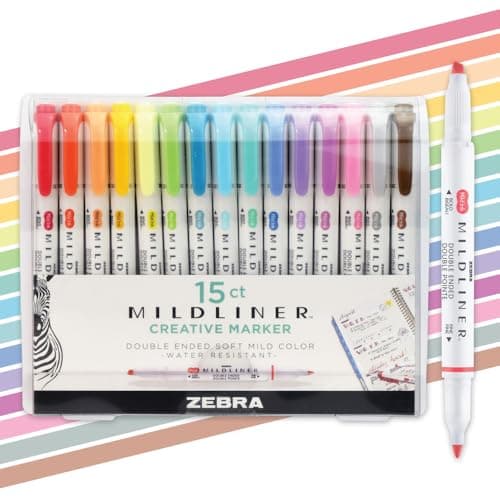 Zebra Mildliner Dual-Tip Highlighters, 15-Pack Water-resistant pigment ink in fifteen soft colors, each with a broad chisel end and a fine bullet end, stated to minimize bleed-through on thin pages. | Pigment ink, dual tip | The default answer | 7.6 | $16.97 on Amazon |
| 2 | 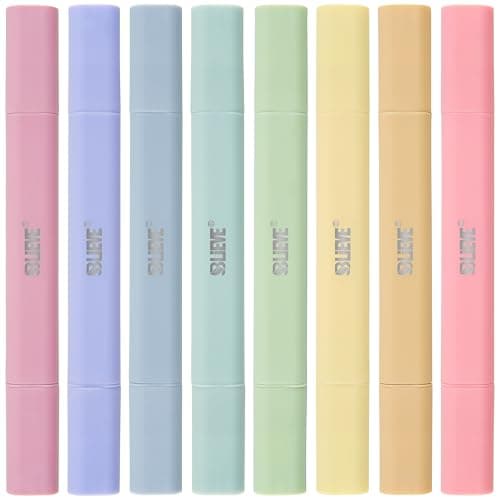 BLIEVE Dual-Tip Bible-Safe Highlighters, 8-Pack Eight pastel dual-tip highlighters with a chisel end and a fine pen end, on ink the seller describes as Bible-safe, fade and water resistant. | Bible-safe ink, dual tip | Dual tips at the cheap end | 6.7 | $7.99 on Amazon |
| 3 | 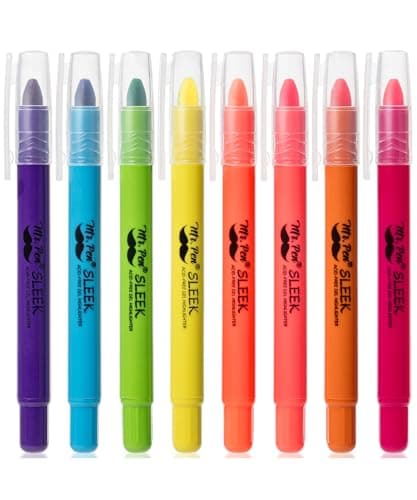 Mr. Pen No Bleed Gel Highlighters, 8-Pack Twist-up gel sticks rather than felt tips — no liquid ink at all, stated not to bleed through any paper including magazines and Bibles, and sharpenable to a finer point. | Twist-up gel stick | Liquid ink, removed entirely | 6.7 | $6.99 on Amazon |
| 4 | 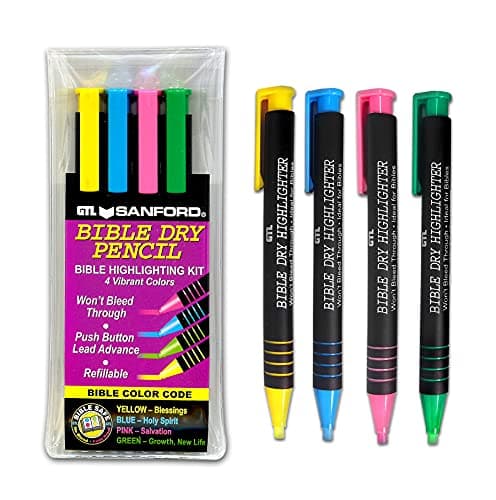 G.T. Luscombe Bible Dry Highlighting Kit, 4-Piece Four refillable dry highlighters that advance like a mechanical pencil, stated archival quality and stated not to bleed through any paper, in a storage pouch. | Dry lead, refillable | The thinnest paper there is | 7.0 | $13.99 on Amazon |
| 5 | 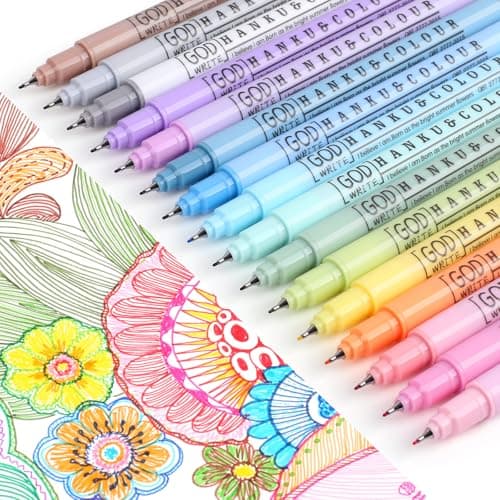 HANKU 0.38 mm Fineliner Pens, 16-Color Set Sixteen water-based fineliners at a published 0.38 mm, in a printed box — the only product on this page that states a tip width. | 0.38 mm tip | Writing in the margin | 7.5 | $19.99 on Amazon |
| 6 | 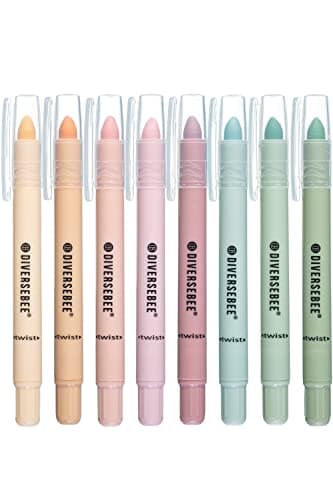 DIVERSEBEE Bible-Safe Dry Highlighters, 8-Pack Eight twist-up pastel dry highlighters, sharpenable, stated not to fade or smear other inks — from a listing whose title promises pens it never describes. | Twist-up dry, sharpenable | Pastel shades, if the count is what you want | 6.3 | $9.95 on Amazon |
| 7 | 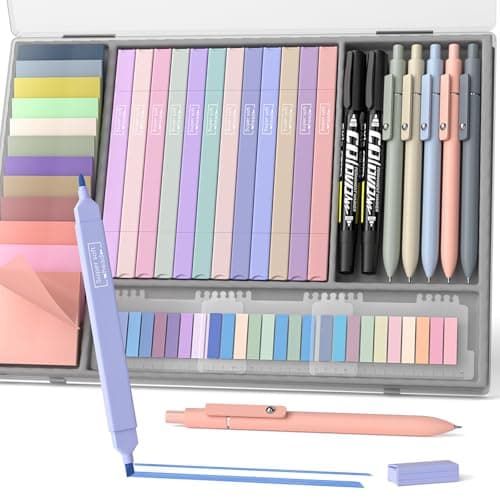 Nicpro Book Annotation Kit with Case, 62-Piece Twelve dual-ended highlighters, five gel pens, two quick-dry markers and 1,200 PET tabs and sticky notes, in a case — the only kit here that comes with somewhere to keep it. | 12 dual-ended highlighters, in a case | The one that arrives ready to give | 7.6 | $16.99 on Amazon |
Anyone who has taken an office highlighter to a paperback knows the failure: a yellow stripe on the page you meant, and a ghost of the same stripe on the page behind it, sitting across a sentence you now cannot read. Novel paper is thin, and a standard highlighter is a felt tip loaded with dye that soaks into fibers rather than sitting on them.
The useful shortcut: look in the Bible aisle
This is the single most helpful thing on this page. The bleed problem was solved decades ago by a different group of readers, because Bible paper is the thinnest paper in common print — often well under half the thickness of a mass-market paperback page — and people have been annotating Bibles for as long as there have been highlighters.
So an entire category of “Bible-safe” markers exists, and five of the six highlighters below say Bible somewhere on the listing. Two things follow. First, a marker built for Bible paper has enormous headroom on a novel. Second, the phrase is not a certification and nobody audits it — it is the aisle's shorthand for ink formulated for thin stock, and you should still read what the seller says the ink actually is.
The three mechanisms, in order of bleed risk
That table is the whole decision. If you annotate ordinary paperbacks, pigment ink with two tips is the convenient choice and the risk is low. If you annotate something with genuinely thin pages, go dry and the problem stops existing rather than being managed.
How we judged this one
- Does the seller name the ink, or only the outcome? “No bleed” is an outcome. “Water-resistant pigment ink” and “dry advancing lead” are mechanisms, and a mechanism is checkable in a way a promise is not.
- Is there a tip width? For a marking tool this is the dimension that matters, and it is the spec that separates the field: exactly one of the seven products below publishes one.
- Two tips or one? Annotating prose means highlighting a line and underlining a phrase in the same breath. A dual-tip barrel does both without putting anything down.
- Published specs, as everywhere on this site. Each pick is scored against the same gift-object checklist; how we score sets out the rest.
Two of the five checklist items — gift packaging and care instructions — are almost never answered anywhere in stationery, so scores here top out at four of five. That is a finding about the aisle, not about the picks, and we leave the checklist alone rather than bend it for one product class.
Highlighting is only half of it
A highlight records that a line mattered. It does not record why, and a month later that is the part you wanted. Which is why anybody who annotates seriously ends up with a pen as well, and why margin width becomes a specification.
A standard ballpoint is around 1.0 mm and a typical gel pen 0.5 or 0.7. At 0.38 mm a full sentence fits in the margin of a mass-market paperback. The fineliner set below is the only product on this page that publishes its tip width, which is why it ranks where it does despite being the least exciting thing here.
The third element is tabs, so you can find the marked page again without leafing through the book. Our annotation tab comparison ranks those on size, material and quantity, and the all-in-one kit at the bottom of this page bundles all three if you would rather buy once.
What we would not buy for a book
- An ordinary office highlighter. Dye ink on a felt tip is the exact combination that produces the ghost on the page behind.
- Anything neon. Not a bleed question, a readability one. A saturated highlight makes the text under it harder to read, which defeats the purpose. Every pick here is a mild or pastel palette for that reason.
- A fountain pen, for margins. Lovely on a journal, wrong on book paper: it lays down far more ink than a fineliner and feathers on uncoated stock.
- A listing that promises pens in the title and never describes them. One of the products below does exactly that, and it is ranked last among the highlighters for it.
- Anything, for a library book. Obvious and worth saying. Annotating is for books you own; for everything else, a reading journal holds the same notes without marking anything.
All seven below are ranked on what their sellers publish, with the blanks printed as blanks — and in this aisle the most common blank is the one that matters most.
Every pick
All of them, in full
Each write-up shows the gift-fit score broken into its five parts, the specs the seller actually publishes, and who should give it a miss.
No. 1 — The default answer
Zebra Mildliner Dual-Tip Highlighters, 15-Pack
Water-resistant pigment ink in fifteen soft colors, each with a broad chisel end and a fine bullet end, stated to minimize bleed-through on thin pages.
| Spec disclosurecomputed | 8 / 20 |
|---|---|
| Gift readinessour call | 14 / 20 |
| Works for any readerour call | 18 / 20 |
| Materials and buildour call | 17 / 20 |
| Everyday useour call | 19 / 20 |
| Total | 76 / 100 |
| Material | Water-resistant pigment ink; stated layerable once dry Seller’s listing, read 2026-09-26 |
|---|---|
| Dimensions | Not published Not published |
| Quantity in pack | 15, with color-coded clips Seller’s listing, read 2026-09-26 |
| Gift packaging | Not published Not published |
| Care instructions | Not published Not published |
The one most people end up with, and for once the popular answer is also the defensible one. Two tips in one barrel is the feature that matters for annotating prose rather than textbooks: the chisel end covers a line, the fine bullet end underlines a phrase or writes a word in the margin, and you are not putting one pen down to pick up another mid-sentence.
The ink is described as water-resistant pigment rather than dye, and that distinction does real work. Pigment sits on the fibers; dye soaks into them, which is what produces the ghost of a highlight on the reverse of a thin page. The seller states the ink is designed to minimize bleed-through rather than to eliminate it, which is a more honest claim than most of this aisle makes.
Fifteen colors is more than a color-coding system needs and exactly right as a gift, because the mild palette is the point: Mildliner colors are deliberately desaturated, so a highlighted line stays readable instead of glowing. If you have ever tried to read under a neon yellow stripe, that is the problem being solved.
Two of five checks. There is no tip width published for either end, which for a fine tip is the figure that decides whether it is a precise underliner or a fat one, and nothing about how it arrives. For the fine-tip question, the fineliner set further down this page is the one that publishes a number.
Give it if
Anyone annotating a novel, a textbook or a journal who wants one pen to do both jobs.
Skip it if
The paper is genuinely Bible-thin. Minimizing bleed is not eliminating it, and a dry highlighter is the safer answer.
No. 2 — Dual tips at the cheap end
BLIEVE Dual-Tip Bible-Safe Highlighters, 8-Pack
Eight pastel dual-tip highlighters with a chisel end and a fine pen end, on ink the seller describes as Bible-safe, fade and water resistant.
| Spec disclosurecomputed | 8 / 20 |
|---|---|
| Gift readinessour call | 12 / 20 |
| Works for any readerour call | 16 / 20 |
| Materials and buildour call | 14 / 20 |
| Everyday useour call | 17 / 20 |
| Total | 67 / 100 |
| Material | Ink described as Bible-safe, quick-drying, fade and water resistant Seller’s listing, read 2026-09-26 |
|---|---|
| Dimensions | Not published Not published |
| Quantity in pack | 8 Seller’s product title, read 2026-09-26 |
| Gift packaging | Not published Not published |
| Care instructions | Not published Not published |
The same dual-tip idea as the pick above at roughly half the count, and the reason to consider it is that the second tip here is described as a pen tip rather than a bullet — the seller expects you to write with it, not just underline.
"Bible-safe" is the phrase to understand across this whole category. It is not a certification and nobody audits it; it is the aisle's shorthand for ink formulated for the thinnest paper in common print. It is a useful signal precisely because Bible paper is thinner than any novel you will annotate, so a pen that survives it has headroom on a paperback.
The palette choice is the other selling point, with six named collections, and it matters more than it sounds for the same reason the Mildliner palette does: a desaturated highlight leaves the text underneath readable.
Two of five, and the blanks are the same as everywhere here — no tip widths and nothing about packaging. The ink claims are also the softest kind: quick-drying, fade resistant and water resistant are all stated without a figure or a standard attached to any of them.
Give it if
Somebody who wants dual tips without buying fifteen colors.
Skip it if
You want the most colors per pack. This is eight against fifteen for a little more.
No. 3 — Liquid ink, removed entirely
Mr. Pen No Bleed Gel Highlighters, 8-Pack
Twist-up gel sticks rather than felt tips — no liquid ink at all, stated not to bleed through any paper including magazines and Bibles, and sharpenable to a finer point.
| Spec disclosurecomputed | 8 / 20 |
|---|---|
| Gift readinessour call | 12 / 20 |
| Works for any readerour call | 15 / 20 |
| Materials and buildour call | 15 / 20 |
| Everyday useour call | 17 / 20 |
| Total | 67 / 100 |
| Material | Gel stick in a twist-up barrel; stated not to dry out uncapped Seller’s listing, read 2026-09-26 |
|---|---|
| Dimensions | Not published Not published |
| Quantity in pack | 8 Seller’s product title, read 2026-09-26 |
| Gift packaging | Not published Not published |
| Care instructions | Not published Not published |
A different mechanism, and the reason to know this category exists. A gel highlighter is a waxy crayon in a twist-up barrel: there is no liquid ink, so there is nothing to soak through the page. Bleed-through stops being a risk to manage and becomes a problem that does not arise.
The trade is precision and finish. A gel stick lays down a wider, softer band than a chisel tip and the edges are less crisp, so a single word is hard to isolate. It also sits on the surface, which means a heavy hand can smudge it before it sets, although this seller specifically claims no smear.
Two genuinely useful details are published. It can be sharpened for a finer tip, which is the answer to the precision problem, and it will not dry out if left uncapped — the single most common way a highlighter dies in a bag.
The claim to read carefully is the first line: no bleed through any paper, including magazines and Bibles. That is the strongest bleed claim on this page and it is the one the mechanism actually supports. Disclosure is still only two of five.
Give it if
Anyone annotating thin or glossy paper, and anyone who keeps killing felt-tip highlighters.
Skip it if
You underline single words. A gel stick is a broad instrument even sharpened.
No. 4 — The thinnest paper there is
G.T. Luscombe Bible Dry Highlighting Kit, 4-Piece
Four refillable dry highlighters that advance like a mechanical pencil, stated archival quality and stated not to bleed through any paper, in a storage pouch.
| Spec disclosurecomputed | 12 / 20 |
|---|---|
| Gift readinessour call | 16 / 20 |
| Works for any readerour call | 12 / 20 |
| Materials and buildour call | 16 / 20 |
| Everyday useour call | 14 / 20 |
| Total | 70 / 100 |
| Material | Dry advancing lead, stated archival quality Seller’s listing, read 2026-09-26 |
|---|---|
| Dimensions | Not published Not published |
| Quantity in pack | 4 — yellow, blue, green, pink Seller’s listing, read 2026-09-26 |
| Gift packaging | Storage pouch with a color-code card Seller’s listing, read 2026-09-26 |
| Care instructions | Not published Not published |
The most committed answer to the bleed problem on this page: there is no ink and no wax, only a colored lead that advances at the push of a button like a mechanical pencil. Nothing can soak through a page because nothing wet touches it.
It is also the only product here that claims archival quality, which is a different and more interesting claim than not bleeding. Archival means it is not expected to fade or to attack the inks already on the page, and on a book somebody intends to keep for decades that is the property that matters — the same argument our book sleeve guide makes about acid-free plastic.
Three of five checks, the joint best on this page, helped by the fact that it arrives in a storage pouch with a color-code card. That makes it the most giftable thing here by some distance; the rest of this aisle arrives as loose pens in a blister pack.
Two honest caveats. Dry highlighting has a distinctly different feel, laying down a lighter, more textured band than ink, and some people dislike it immediately. And stock on this one was low when we read the listing, so check availability rather than assuming — any refillable dry highlighter works on the same principle if this one is gone.
Give it if
Somebody annotating genuinely thin paper, or a book they expect to keep for decades.
Skip it if
You want a saturated, even band of color. Dry lead is lighter and more textured than ink.
No. 5 — Writing in the margin
HANKU 0.38 mm Fineliner Pens, 16-Color Set
Sixteen water-based fineliners at a published 0.38 mm, in a printed box — the only product on this page that states a tip width.
| Spec disclosurecomputed | 16 / 20 |
|---|---|
| Gift readinessour call | 15 / 20 |
| Works for any readerour call | 14 / 20 |
| Materials and buildour call | 14 / 20 |
| Everyday useour call | 16 / 20 |
| Total | 75 / 100 |
| Material | Water-based ink, stated quick-drying and non-bleeding Seller’s listing, read 2026-09-26 |
|---|---|
| Dimensions | 0.38 mm tip Seller’s listing, read 2026-09-26 |
| Quantity in pack | 16 colors Seller’s product title, read 2026-09-26 |
| Gift packaging | Printed paper box Seller’s listing, read 2026-09-26 |
| Care instructions | Not published Not published |
The pens half of the job, and the best-documented product on this page at four of five checks. Highlighting marks which line mattered; a pen is how you say why, and a margin is a narrow place to write.
0.38 mm is the number that makes it work, and it is the only tip width published by anyone here. For context, a standard ballpoint is around 1.0 mm and a typical gel pen 0.5 or 0.7. At 0.38 a full sentence fits in the margin of a mass-market paperback, which is the whole point.
Sixteen colors is more than a margin needs and turns it into a color-coding set that matches a highlighter palette, which is how people who annotate seriously actually work: one color for a line they loved, one for a question, one for something to look up.
Water-based ink is a genuine consideration on the thinnest paper. It is the same family as a felt-tip, which means the no-bleed claim here rests on the tiny amount of ink a 0.38 mm point puts down rather than on a different mechanism. On Bible-thin paper a ballpoint or a pencil is still the safer tool.
Give it if
Anyone who writes in margins rather than only highlighting.
Skip it if
The paper is very thin and the notes are long. Water-based ink at length is more risk than a pencil.
No. 6 — Pastel shades, if the count is what you want
DIVERSEBEE Bible-Safe Dry Highlighters, 8-Pack
Eight twist-up pastel dry highlighters, sharpenable, stated not to fade or smear other inks — from a listing whose title promises pens it never describes.
| Spec disclosurecomputed | 8 / 20 |
|---|---|
| Gift readinessour call | 12 / 20 |
| Works for any readerour call | 14 / 20 |
| Materials and buildour call | 13 / 20 |
| Everyday useour call | 16 / 20 |
| Total | 63 / 100 |
| Material | Dry twist-up sticks; stated not to fade or smear over other inks Seller’s listing, read 2026-09-26 |
|---|---|
| Dimensions | Not published Not published |
| Quantity in pack | 8 colors Seller’s listing, read 2026-09-26 |
| Gift packaging | Not published Not published |
| Care instructions | Not published Not published |
Mechanically this is the same idea as the gel sticks above — a twist-up dry stick with no liquid ink — in a pastel palette and with the same sharpen-for-a-finer-tip trick. If the eight shades are the ones you want, it does the job.
The useful published line is that it will not smear the inks already on the page. Highlighting over printed text is not the risk; highlighting over your own ballpoint note from last week is, and most listings in this aisle never mention it.
Now the reason it ranks last among the highlighters. The title says "Bible Highlighters and Pens" and not one of the six bullets describes a pen — every line is about highlighters, their colors and their twist-up design. We do not know from this listing whether pens are included, how many, or what tip they have.
That is a quantity question on a product whose quantity is its main specification, and this site treats a listing that contradicts itself as a finding rather than a detail. If you want pens, the fineliner set above tells you exactly what you are getting and publishes the tip width.
Give it if
Somebody who wants dry highlighters in pastel and does not need the pens.
Skip it if
You are buying it for the pens in the title. The listing never describes them.
No. 7 — The one that arrives ready to give
Nicpro Book Annotation Kit with Case, 62-Piece
Twelve dual-ended highlighters, five gel pens, two quick-dry markers and 1,200 PET tabs and sticky notes, in a case — the only kit here that comes with somewhere to keep it.
| Spec disclosurecomputed | 12 / 20 |
|---|---|
| Gift readinessour call | 17 / 20 |
| Works for any readerour call | 15 / 20 |
| Materials and buildour call | 15 / 20 |
| Everyday useour call | 17 / 20 |
| Total | 76 / 100 |
| Material | PET tabs and sticky notes, stated waterproof and residue-free; ABS pen barrels Seller’s listing, read 2026-09-21 |
|---|---|
| Dimensions | Not published Not published |
| Quantity in pack | 12 highlighters, 5 gel pens, 2 markers, 600 sticky notes, 600 index tabs Seller’s listing, read 2026-09-21 |
| Gift packaging | Supplied with a case Seller’s product title, read 2026-09-21 |
| Care instructions | Not published Not published |
The case is why this one ranks where it does. Every other kit in this category arrives as a bundle of shrink-wrapped stationery, which is fine for yourself and awkward to hand over. A zipped case turns the same contents into something that looks bought on purpose, and it is also the thing that keeps the kit together in a school bag instead of scattered through it.
Dual-ended highlighters are the other real difference: a chisel tip for covering a line and a fine tip for underlining a phrase, in one barrel. For annotating prose rather than textbooks, the fine end gets more use than the broad one, and buying single-tip highlighters means finding that out afterward.
The tab material is named and the claim is specific — PET, waterproof, and stated to leave no residue on the page. Residue is the complaint that matters for anybody tabbing a book they care about, and it is the one most listings do not address at all.
Three of five checks. The blanks are dimensions, which the Roamall kit publishes and this one does not, and care instructions, which nothing in this aisle publishes. Sixty-two pieces plus 1,200 tabs is also a lot of stationery for a small case, so expect it to be full.
Give it if
A gift buyer who wants the annotating kit to look like a present rather than a supply run.
Skip it if
They already have highlighters and just want tabs. The cheaper kit gives five times as many.
Answers
Questions people actually ask
What highlighters do not bleed through book pages?
Three kinds, in order of safety. Dry highlighters use a colored lead that advances like a mechanical pencil, so nothing wet touches the page at all. Gel or wax sticks are twist-up crayons laid on the surface. Pigment-ink felt tips sit on the fibers rather than soaking into them, which is the convenient middle ground. The one to avoid is an ordinary office highlighter, which uses dye ink that soaks in.
Why are Bible highlighters recommended for books?
Because Bible paper is the thinnest paper in common print, often well under half the thickness of a paperback page, and an entire category of markers was formulated for it. A marker that survives Bible paper has a lot of headroom on a novel. Worth knowing: Bible-safe is not a certification and nobody audits it — it is the aisle's shorthand, so still read what the seller says the ink actually is.
What pen is best for writing in book margins?
A fineliner with a published tip width, around 0.38 mm. For context a standard ballpoint is roughly 1.0 mm and a typical gel pen 0.5 or 0.7, and at 0.38 a full sentence fits in the margin of a mass-market paperback. Only one of the seven products on this page publishes a tip width at all, which tells you something about the category. On genuinely thin paper, a pencil is still the safest tool of all.
How do you highlight a book without ruining it?
Test on the last page first — paper stock varies between print runs of the same title, and thirty seconds on the inside back cover tells you what no listing can. Then pick by mechanism rather than by promise: dry or gel if the paper is thin, pigment ink if it is normal. Avoid neon shades, which make the text underneath harder to read, and never do any of it to a borrowed or library book.
Do highlighters score badly on this site?
Lower than most categories, yes, and it is partly the checklist. We score every gift object on the same five items, two of which — gift packaging and care instructions — are effectively never published anywhere in stationery, so four of five is the ceiling here. Beyond that, six of the seven products publish no tip width, which for a marking tool is the dimension that matters most.